Back to Resources

A partnership falls apart. A lender stops trusting management. A regulator finds enough evidence of fraud to act. In each case, one of the interested parties can file a motion asking the court to place a business, property, or set of assets under the control of a neutral third party. That process is called a receivership.
For the parties involved, the questions that follow are usually the same. What does the receiver actually do? How long does it last? Will the business survive? Here is a straightforward guide based on 20+ years of doing this work.
A Receivership Practice Built on Hundreds of Court-Appointed Engagements
Our partners have acted as receiver, financial advisor to receivers, partition referee, liquidating trustee, and independent fiduciary across hundreds of court-appointed engagements. Our work spans matters involving single-property cases to multi-hundred-million-dollar disputes.
Examples from our caseload include:
- A $300 million real estate portfolio of eight large properties, with Howard Grobstein acting as an independent fiduciary
- A federal equity receivership in which Josh Teeple was appointed by the Federal Trade Commission over a subscription business that violated consumer protection rules
- Howard Grobstein was appointed by court’s special master to calculate and segregate worldwide net income involving an intellectual property dispute between two international toy manufacturers
- Financial advisors to a receiver wherein we conducted the day-to-day operations, financial reporting, and sales of six large car dealerships
Receiverships rarely look the same from one case to the next. The thread that runs through all of them is neutrality, financial expertise, and court supervision. That is the lens GT works through.
The Two Roles GT Play
In any given receivership, GT steps into one of two positions. Both require the same financial discipline. The difference is who holds the court-appointed authority.
Acting as the receiver
When the court appoints one of GT’s partners as receiver, GT assumes custodial control over the business, property, or assets in question. From that point forward, the receiver answers to the court alone. Even the party that filed the motion to have GT appointed cannot expect favorable treatment.
Howard Grobstein explains, “Even though one party got you appointed and they were the ones that filed the motion, you are now neutral, and you can’t favor one side or the other.”
The receiver usually is given the authority to retain other professionals, including lawyers, financial advisors, real estate brokers, and others necessary to satisfy the objectives of the receivership.
Acting as the financial advisor to a receiver
In many cases, the appointed receiver is a lawyer or a business specialist who needs accounting and forensic consulting capabilities behind them. “That is where much of our receivership work sits,” Josh Teeple puts it plainly. “We often act as financial advisors and accountants to receivers.”
In that role, GT typically handles the forensic reconstruction, monthly financial reporting, and tax compliance for the receiver.
The Receivership Process
A receivership begins with a motion and ends with a court discharge. The path between those two points is where all the challenging work is performed.
1. A motion to appoint a receiver is filed
A party files the motion with the court providing evidence supporting the request. A lender will show that its collateral is at risk. A partner may show they have been cut out of the business. A regulator will present evidence of fraud or regulatory violations.
2. The court rules on the motion
The judge has three options. They can deny the motion, continue it pending further evidence or modification of the receiver’s potential duties, or approve the motion. The moving party usually submits a draft order spelling out the receiver’s authority.
3. The order defines full or limited authority
The judge can grant a full receivership or limit specific powers and create a limited receivership. When the scope is narrowed, the parties must weigh whether the limitations of authority are sufficient to achieve the objectives of the receivership.
4. The receiver takes control immediately
Once appointed, the receiver is responsible for the business from that moment. Cash and accounts are secured. Records are reviewed. Operations are stabilized or wound down depending on the order.
5. The receiver reports to the court
Detailed accounting, regular status reports, and approval of any major decisions flow through the court throughout the process.
6. Resolution and discharge
The matter resolves through a sale, a buyout, a distribution to creditors, or a transition to bankruptcy. The receiver is discharged when the court is satisfied that the mandate has been fulfilled.
What Triggers a Receivership
There are three primary reasons a receiver gets appointed.
A dispute between owners, shareholders, or partners
A receivership is often the result of a dispute between business owners. One party feels aggrieved, has lost access or control, or believes the other side is mismanaging or siphoning money. They go to court and ask for a neutral receiver to step in while the underlying dispute is litigated.
A lender protecting its collateral
A bank or secured lender becomes concerned that the business securing its loan is being mismanaged. Rather than wait for the borrower to fail, the lender files a motion asking the court to appoint a receiver to protect the collateral. This is one of the most common types of receivership.
Regulatory enforcement by a government agency
The Securities and Exchange Commission, the Federal Trade Commission, the FBI, or a similar agency builds a case against an entity for fraud or for violating regulatory rules. They typically go to court on an emergency basis and ask for the appointment of a receiver. These are sometimes called regulatory receiverships.
Other types
Courts also appoint receivers in narrower contexts. A rents and profits receiver collects rents on a building when a lender is concerned about its collateral. A partition referee is appointed to sell a property when co-owners cannot agree on the disposition of the real estate. A health and safety code receiver is fast-tracked at the county or state level when a building fails safety standards. These engagements are typically smaller in scope than the three primary categories above.
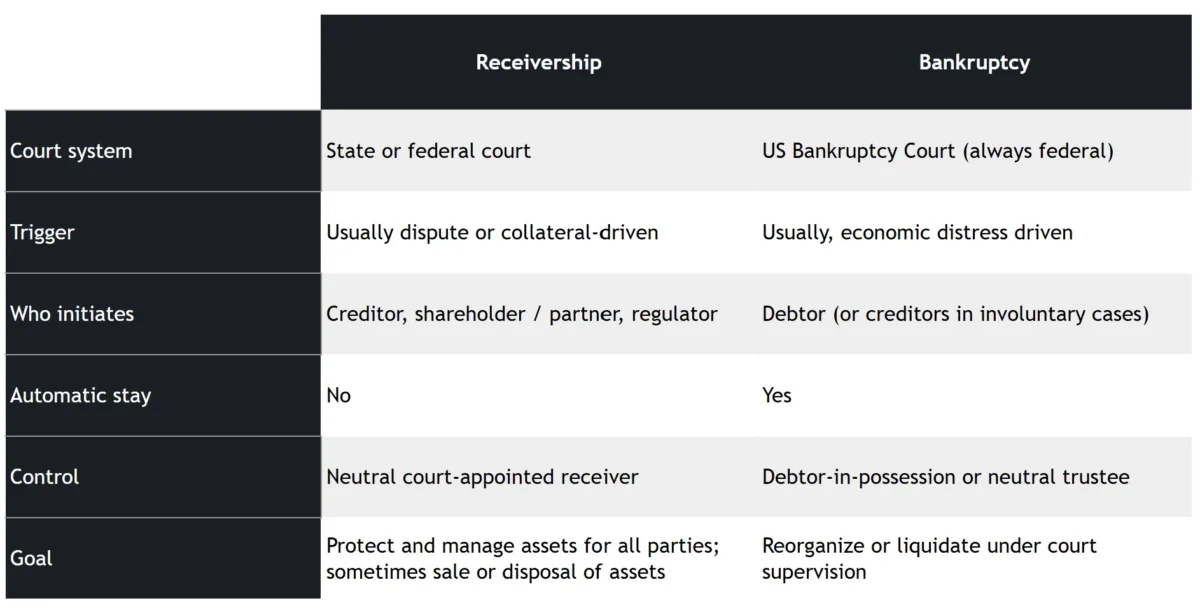
The two processes can intersect. A receiver may have an obligation to put a company into bankruptcy if the situation calls for it. A bankruptcy court can sometimes allow the receiver to continue serving as the trustee. They are separate court systems running on separate tracks, but a single matter can move between them.
What Happens to the Business During a Receivership
When the receiver is appointed, existing management typically loses control. The receiver makes decisions about operations, staffing, contracts, and assets. In some cases, the business continues to operate under the receiver’s supervision. In others, the receiver begins an orderly wind-down or sale.
The receiver’s job is to manage the transition in a way that preserves value and fulfils the court’s mandate. Throughout the process, the receiver is accountable to the court, not to any individual creditor or owner.
Frequently Asked Questions
What is the difference between a trustee and a receiver?
A trustee is appointed within the bankruptcy system, usually to manage a financially distressed company through bankruptcy or liquidation. A receiver is appointed by a court outside the bankruptcy system, usually in a civil dispute, a lender enforcement action, or a regulatory matter.
Can a business survive a receivership?
Yes. In a partner dispute, one partner may end up buying the other out. In a lender case, the business may be sold as a going concern. In a regulatory case, a sale or wind-down is more likely. The outcome depends on the type of receivership and what the court orders.
How long does a receivership last?
A simple property receivership might last a few months. Regulatory receiverships and complex business cases involving litigation, tax issues, and multiple creditor claims can run for years. The receiver is discharged when the court is satisfied that the mandate has been fulfilled.
Who pays for the receiver?
The receiver is generally paid from the assets under receivership, and the compensation is subject to court approval. Where there is no operating business, the secured creditor or the moving party can fund the work, sometimes through receiver certificates that document loans to the receivership estate.
What triggers a receivership in real estate?
The most common trigger is a loan default on a commercial or income-producing property. The lender files a motion asking the court to appoint a receiver to take control of the property, collect rents, and preserve the asset’s value during a sale process.
When You Need an Experienced Receiver
The judge and the receiver appointed in the case will set the tone for everything that follows. Experience, neutrality, and financial depth are essential qualities for a receiver in any type or size matter.
GT’s professionals regularly assume the roles of receiver, provisional director, partition referee, financial advisor to the receiver, and financial advisor to outside parties involved in the receivership. GT also serves as liquidating trustee, estate trustee, and disbursing agent. We turn complicated financial problems into practical solutions and stay with you from the first court order through to discharge.
If you are an attorney, lender, or business owner facing a situation that may involve a receivership, it’s go time. We go all out for you.
Contact us to speak with a receivership expert.
We provide expert restructuring and insolvency services coast to coast. Learn more about our Restructuring and Insolvency practice or our Independent Fiduciary services.
Personal Finance
18 May 2026
 8 minute read
 Recent Insights

-
Financial Review vs Audit: Which One Do You Actually Need?Accounting Service General Business17 Jun 2026
10 minute read
Some business expenses are unavoidable. Audits and financial statement reviews are among them. While they can be costly and are rarely welcome, ...
-
What Is a Receivership? How It Works and What to ExpectPersonal Finance18 May 2026
8 minute read
A partnership falls apart. A lender stops trusting management. A regulator finds enough evidence of fraud to act. In each case, one of the interest...
-
Selling a Business: What You Need to Know Before You Go to MarketBusiness Strategy General Business3 Jun 2026
3 minute read
Most owners spend years building a valuable business yet approach the sale with far less preparation than it deserves. We sat down with professi...
-
Why a Forensic Accountant is Essential in Family Law and Divorce CasesUncategorized8 Apr 2026
5 minute read
In most divorce proceedings, obtaining a clear financial picture is fundamental to the outcome of the case. One spouse says the business earns X. T...
-
What Is the Value of My Company?Business Strategy3 Mar 2026
2 minute read
If you're asking, "What is the value of my company?" - you're not alone. Many business owners don't have a clear answer and often rely on rules of ...
-
Agreed-Upon Procedures: How An AUP Engagement Can Meet Your NeedsBusiness Strategy3 Mar 2026
3 minute read
What Agreed-Upon Procedures Actually Are Agreed-upon procedures (AUP) engagements let you zero in on specific accounting records, financial data...
-
You’re Probably Paying too Much in Taxes (Here’s Why)Uncategorized27 Feb 2026
2 minute read
No tax strategy? You may be overpaying. Tax season is approaching, and for many businesses, that means scrambling to file before the tax deadlin...
-
Trump’s Big Beautiful Bill: What You Need to Know NowBusiness Tax General Business2 Sep 2025
7 minute read
The 2025 tax legislation is here, and it's time to get strategic. President Trump's latest tax reform, formally titled the 2025 Tax Relief and E...
-
Why Engaging a Litigation Expert Witness Early Wins Complex Financial CasesBusiness Strategy17 Sep 2025
5 minute read
Engaging a litigation expert witness early can make the difference between a strong argument and a winning case; especially when financial damages ...
-
Why an Independent Fiduciary Protects Business ValueBusiness Strategy Advisory22 Jul 2025
4 minute read
An independent fiduciary provides the objective oversight, conflict-free decision-making, and governance stability U.S. businesses and families nee...
-
Grobstein Teeple LLP Joins the Prestigious Alliott Global Alliance and Expands Global CapabilitiesCompany News General Business1 Jul 2025
3 minute read
Los Angeles firm, Gropstein Teeple LLP, gains international reach through admission into prestigious professional services network, Alliott Global ...
-
How the Right Audit Preparation Can Save Your Firm Time and MoneyBusiness Tax General Business24 Apr 2025
4 minute read
A financial statement audit can be a costly and time-consuming process, which is why seeking expert advice on audit preparation is essential to eas...
-
Withstanding the Unexpected: How a Red File Can Help You Bounce BackPersonal Finance Advisory30 May 2025
5 minute read
One of the few certainties in life is that it can be unpredictable. That’s why a Red File is so important—because it can help you recover quickly f...
-
How Will President Trump’s IRS Hiring Freeze Affect Tax Season?Uncategorized4 Mar 2025
3 minute read
While there was an expectation of some unpredictability from President Trump’s second term in office, a number of new executive orders are causing ...
-
Trump and 2025 Tax Brackets: Here’s What We’re Advising our Clients to Watch Out ForTax & Compliance Industry Updates9 Jan 2025
5 minute read
Many of our clients have asked us what will change—including whether there will be any changes to 2025 tax brackets—once president-elect Donald Tru...
-
The Corporate Transparency Act Is on Hold— But That May Be TemporaryBusiness Tax Industry Updates12 Dec 2024
3 minute read
Beneficial Ownership Information, or BOI reports, are now voluntary until further notice. However, Grobstein Teeple still recommends clients gather...
-
When It Comes to Home Cybersecurity, You Can’t Afford to Overlook Your SetupCybersecurity Cybersecurity24 Oct 2024
6 minute read
Working remotely? Don’t forget the crucial role your home cybersecurity setup plays in keeping your personal information safe and secure. We’ve ...
-
Ever Wondered How to Calculate Business Valuation? Start by Talking to an ExpertBusiness Tax Advisory3 Oct 2024
5 minute read
Do you know how to calculate business valuation accurately when there are competing interests involved? It’s a question Grobstein Teeple’s business...
-
Need Forensic Accounting? You’ve Come to the Right PlaceAccounting Service Protection11 Sep 2024
6 minute read
Forensic accounting might not be the most traditional of services that come to mind when you think of accounting, but it’s a field Grobstein Teeple...
-
What Is Bankruptcy and Insolvency? You’ll Want an Expert to Answer ThatWealth Planning General Business14 Jul 2024
5 minute read
It’s not a topic any business owner ever wants to face, but failure to consult a bankruptcy and insolvency expert can cost you even more in the lon...
-
We Do More Than Just Tax Planning and ComplianceAccounting Service Advisory21 May 2024
6 minute read
While the month of May often brings a sigh of relief for individuals who’ve just filed their income tax returns, Grobstein Teeple does more than ju...
-
Building a Successful Business? Don’t Forget About AccountingBusiness Strategy General Business17 Apr 2024
2 minute read
When it comes to building a successful business, it’s key to get your accounting right. That’s the verdict from our Principal, Dimple Mehra, who...
-
It’s ‘Go Time’ Once Again at the California Bankruptcy ForumAccounting Service Advisory5 Apr 2024
6 minute read
The California Bankruptcy Forum is hosting its 36th annual insolvency conference in May and Grobstein Teeple will again be an active participant. ...
-
Have You Ever Wondered Why Business Valuation Is So Important?Business Strategy Advisory7 Mar 2024
4 minute read
Why is business valuation important? Grobstein Teeple’s experienced business valuation experts, Kurt Stake and Will Thomsen, have the answers. W...
-
Howard Grobstein Named One of LA’s Top 100 AccountantsCompany News Company news9 Nov 2023
5 minute read
Howard Grobstein didn’t co-found Grobstein Teeple with the express purpose of being named one of LA's Top 100 Accountants, but it’s an accolade tha...
-
The Four Best Practices of Staying Safe OnlineBusiness Strategy Cybersecurity23 Oct 2023
7 minute read
October marks Cybersecurity Awareness Month each year—the joint initiative between the U.S. Department of Homeland Security and National Cybersecur...
-
Why Cybersecurity is More Important Than EverBusiness Strategy Cybersecurity13 Oct 2023
8 minute read
“Certain kinds of cybercrime that were considered avant garde or cutting edge in 2004 or 2005 are now daily occurrences.” That’s the verdict of...
-
October Is Cybersecurity Awareness MonthPodcast Cybersecurity29 Sep 2023
1 minute read
It's Cybersecurity Awareness Month and here at Grobstein Teeple, we’re thrilled to play our part. Our Global Head of Cybersecurity and Risk Mana...
-
Postponed California Tax DeadlinesPersonal Tax9 Mar 2023
3 minute read
Postponed deadlines for disaster-affected taxpayers in California. The Internal Revenue Service has announced that the postponement of various t...
-
Time for business evolutionCompany News16 Mar 2023
3 minute read
Brand History We grew from a desire to combine the expertise provided by a larger firm with a leaner, more flexible approach that puts our c...