Back to Resources

Some business expenses are unavoidable.
Audits and financial statement reviews are among them. While they can be costly and are rarely welcome, banks, vendors, and investors often require them before lending, signing agreements, or listing your business. They need an assessment of your financial position—and evidence to support it—before making a commitment.
What many don’t realize is that an audit is the most expensive service, and a large share of businesses paying for one never actually need it to begin with. A reviewed financial statement would have satisfied the bank, cost a fraction of the price, and been done in a fraction of the time.
Here’s the problem: most business owners don’t know the difference between an audit and a review of financial statements. Let’s break down the difference between the two and when you would need one or the other.
First, What “Assurance” Actually Means
Assurance is the umbrella term for the work certified public accountants do to give an outside party confidence in your financial statements. Banks, investors, buyers, bonding agencies, and regulators are all stakeholders who want that confidence before they lend, invest, or sign. The purpose of an assurance engagement is to enhance the credibility of your financial reporting in their eyes.
There are three levels of assurance:
- Audit. The highest level of assurance. A CPA independently verifies the numbers in accordance with generally accepted accounting principles (GAAP) and gives an opinion providing reasonable assurance that the financial statements are free from material misstatement.
- Review. The middle level. The CPA performs inquiry and analytical procedures and gives a moderate level of assurance rather than full verification of your financial position.
- Compilation. The lowest level. The accountant presents your financial statements in proper format with no assurance attached.
Most of this article is about the two that matter for the typical business: the distinction between a financial statement review and an audit.
What a Financial Statement Review Involves
A financial statement review is built on analytical procedures and inquiries of key company personnel. In a review engagement, the CPA holds discussions with management, performs analytical analyses in the accounting records, and looks for anything inconsistent with accounting standards. Reviews do not involve detailed testing of transactions down to the source documents, which makes reviews less comprehensive and less expensive than audits.
A review provides enough comfort that, for many small to medium-sized businesses (SMEs), a reviewed financial statement is all a lender asks for. It gives a clear read on financial position and financial information without the cost of a full audit.
“Most clients don’t actually know whether they need an audit or a review,” says Eric Tischofer, an audit partner at GT. “They come to us because someone told them they need ‘assurance,’ and our first job is to figure out which level they actually need. A lot of the time, a review covers it.”
What an Audit Involves
An audit is a larger undertaking. The auditor does not accept the numbers based solely on inquiry and analysis. They prove them out. An audit engagement means detailed testing of transactions, confirming balances with third parties, evaluating your internal controls, and gathering appropriate evidence from source documents. Yes, that means asking for the receipts.
That rigor is the point. Performing required audit procedures, the auditor independently tests the veracity of the financial statement numbers and issues an auditor’s report that results in the highest level of assurance a CPA can provide. An independent audit provides reasonable assurance that the financial statements are free from material misstatement, a higher level of assurance than a review can offer. A financial statement audit takes longer and costs more.
Financial Review vs Audit at a Glance
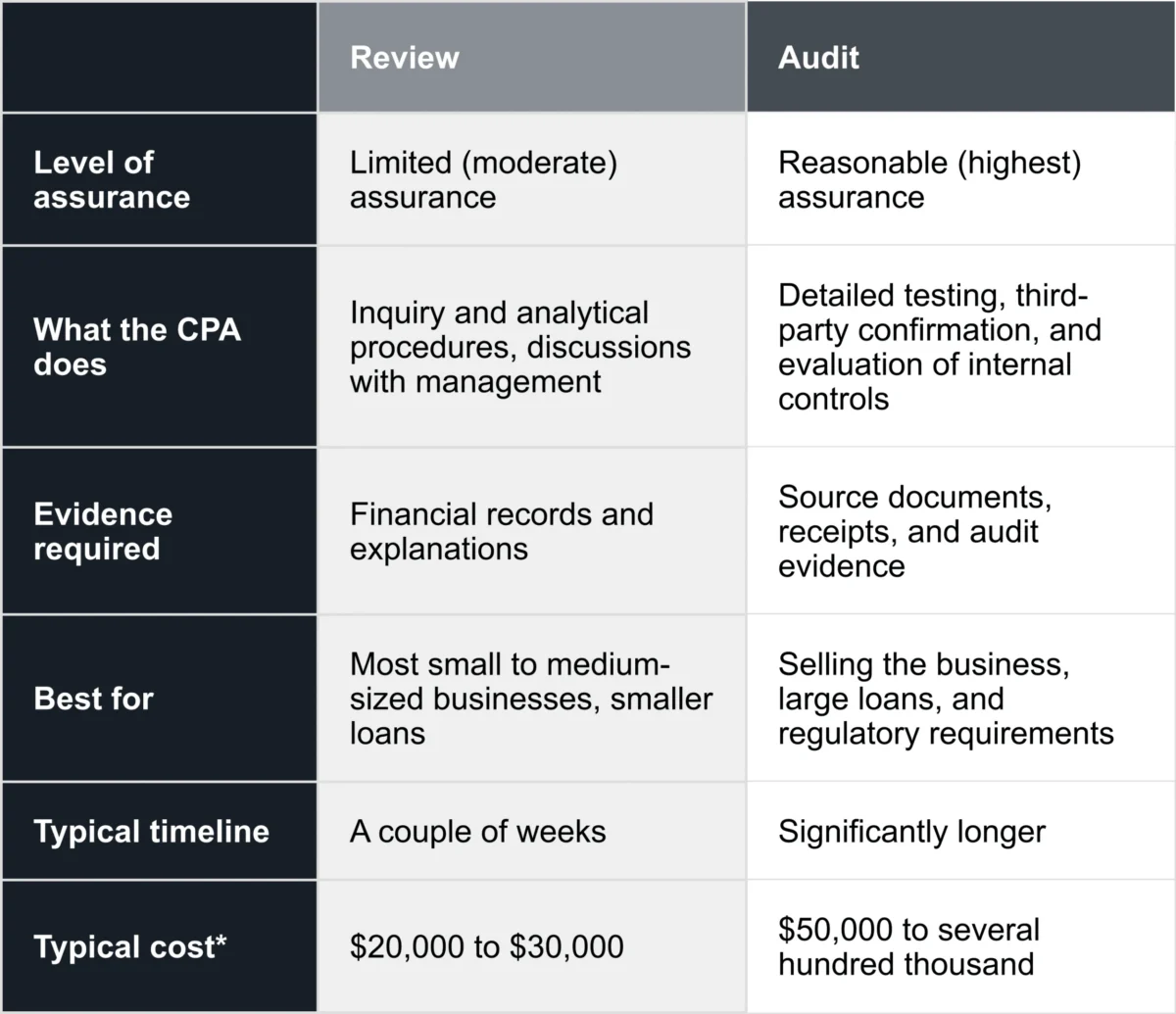
Both services are performed by CPAs, both result in financial statements that have been independently tested, and both follow GAAP. The difference is the degree of testing by the CPA.
When You Need an Audit
There are clear situations where an audit is required or necessary:
- You are selling your company. A buyer may require audited financial statements as part of their due diligence.
- You are taking on a very large loan. Think high seven figures and up.
- A platform, investor, or regulator requires it. Most won’t accept anything but an audit.
Public companies and entities answerable to regulatory bodies sit in a category of their own. When a regulator sets the rules, an audit is usually not optional. Regulatory and legal requirements dictate the level of assurance you must provide, and a review will not meet those standards in such cases.
A useful rule of thumb on lending: if your other numbers are healthy, many banks will often lend up to around $5 million on the strength of a review. Above that, or if you’re selling the business, you are likely into audit territory.
When a Review Is Enough
Here’s what many CPAs won’t tell you: for most businesses, most of the time, a review does the job.
To a small business owner, borrowing a couple of million dollars feels like a huge loan. To a bank, it isn’t, and a review is usually plenty to support it. “Reviews are inquiry and analytical procedures, done in a couple of weeks,” Erik explains. “An audit means we literally need to see receipts, and can take months. If you don’t need that, there’s a lot of value in not paying for it.”
Erik has seen it play out more than once in his career. In one case, a small investment fund was told it needed a $60,000 audit before a platform would list its investments. For a fund only a couple of million dollars in size, that annual cost was close to business-breaking. After a conversation with the platform, a review was accepted instead. It cost around $20,000, saved the fund roughly $40,000 a year, and kept the whole venture viable.
In another, a chain of tire shops needed a loan to get through a liquidity squeeze. Their books were messy, and a first-time audit would have taken months they did not have. A review was completed in ten days. They got the loan, and the business survived.
When a Review Tells You That You Need an Audit
The honesty cuts both ways. Sometimes a client asks for a review, and the review itself reveals the books are in no shape to be relied on.
“It often goes the other way too,” says Wes Elair, one of GT’s audit partners. “A client asks for a review, we start digging in, and the financials are so messy they can’t be fully trusted. At that point, we recommend an audit, and the owner usually understands exactly why.”
What surprises those clients is what the audit gives back. The process forces internal controls into place, builds in segregation of duties, and can surface inefficiencies across departments.
“Once you have real processes and several layers of validation, everyone does their job, and they do it right,” Wes notes. “Clients see that value and keep doing audits year over year, because the efficiencies they gain often save them more than the audit costs.”
That is the quiet upside of an audit done well. It is not just a stamp for the bank. It is a structural tune-up for the business.
Two Experts Who Have Run Audits and Reviews Many Times
Erik Tischofer, a partner, has spent 12 years in public accounting. He began his career at KPMG auditing publicly traded companies, including large military manufacturers, and government entities such as the Department of Energy and the Department of the Interior. He then spent seven years at a regional CPA firm, helping build the audit practice from four people to twenty-five. Across his career, he has audited and reviewed more than 100 companies.
Wes Elair, a partner, has been a CPA for 14 years and is licensed in two countries. He started in Tunisia, auditing major institutions including the Central Bank of Tunisia, along with French multinationals operating across Africa. For the past seven years, he has worked across US industries, including manufacturing, services, nonprofits, and employee benefit plans, which is the category that covers 401(k) audits.
Frequently Asked Questions
What is the difference between a financial review and an audit?
A review is based on inquiry and analytical procedures and provides limited assurance. An audit independently verifies the numbers through testing and third-party confirmation and provides reasonable assurance, the highest level a CPA can give. An audit costs more and takes longer.
Is a financial statement review the same as a financial review?
Yes. A review, a financial review, and a financial statement review all refer to the same service.
How much does a financial review cost compared to an audit?
A review commonly runs from about $20,000 to $30,000. An audit commonly starts around $50,000 and can run into the hundreds of thousands depending on the size and complexity of the business.*
Will my bank accept a review instead of an audit?
Often, yes. If your numbers are otherwise healthy, many banks will lend up to around $5 million on the strength of a reviewed financial statement. Larger loans, a sale of the business, or specific investor and regulator requirements can push you into audit territory. The only way to know is to ask your lender, and we can help you have that conversation.
What is a compilation?
A compilation is the lowest level of assurance service. The CPA presents your financials in proper format without providing any assurance on them. It sits below a review.
Does an audit detect fraud?
An audit is designed to obtain reasonable assurance that the financial statements are free of material misstatement, whether caused by error or fraud, and our procedures include steps directed at identifying fraud risk. That said, an audit provides reasonable, not absolute, assurance — certain frauds, particularly those involving collusion or deliberate concealment, may not be detected even in a properly planned and performed audit.
Not Sure Which One You Need? That’s the Point of a Conversation
First-time clients rarely know what they actually need. Someone, a bank, a vendor, a bonding agency, an insurer, told them to get “assurance,” and they go looking for it without much to go on.
That is exactly where we come in. We run audit and review engagements all year long, and we match the service to your business needs rather than to the biggest invoice. Tell us your situation, and we will tell you straight whether a review covers it or whether an audit is genuinely the right move. If a review is enough, we’ll say so. If your books point to an audit, we’ll explain why and what you’ll get out of it.
It’s go time. We go all out for you.
Talk to us about a financial review or an audit.
Learn more about ourAssurance and Taxation services or our Financial Statement Audit Preparation work. Questions? Call us at 818.532.1020.
*Every situation is unique based on the type and complexity of the business financial statements being reviewed or audited.
Accounting Service
17 Jun 2026
 10 minute read
 Recent Insights

-
Financial Review vs Audit: Which One Do You Actually Need?Accounting Service General Business17 Jun 2026
10 minute read
Some business expenses are unavoidable. Audits and financial statement reviews are among them. While they can be costly and are rarely welcome, ...
-
What Is a Receivership? How It Works and What to ExpectPersonal Finance18 May 2026
8 minute read
A partnership falls apart. A lender stops trusting management. A regulator finds enough evidence of fraud to act. In each case, one of the interest...
-
Selling a Business: What You Need to Know Before You Go to MarketBusiness Strategy General Business3 Jun 2026
3 minute read
Most owners spend years building a valuable business yet approach the sale with far less preparation than it deserves. We sat down with professi...
-
Why a Forensic Accountant is Essential in Family Law and Divorce CasesUncategorized8 Apr 2026
5 minute read
In most divorce proceedings, obtaining a clear financial picture is fundamental to the outcome of the case. One spouse says the business earns X. T...
-
What Is the Value of My Company?Business Strategy3 Mar 2026
2 minute read
If you're asking, "What is the value of my company?" - you're not alone. Many business owners don't have a clear answer and often rely on rules of ...
-
Agreed-Upon Procedures: How An AUP Engagement Can Meet Your NeedsBusiness Strategy3 Mar 2026
3 minute read
What Agreed-Upon Procedures Actually Are Agreed-upon procedures (AUP) engagements let you zero in on specific accounting records, financial data...
-
You’re Probably Paying too Much in Taxes (Here’s Why)Uncategorized27 Feb 2026
2 minute read
No tax strategy? You may be overpaying. Tax season is approaching, and for many businesses, that means scrambling to file before the tax deadlin...
-
Trump’s Big Beautiful Bill: What You Need to Know NowBusiness Tax General Business2 Sep 2025
7 minute read
The 2025 tax legislation is here, and it's time to get strategic. President Trump's latest tax reform, formally titled the 2025 Tax Relief and E...
-
Why Engaging a Litigation Expert Witness Early Wins Complex Financial CasesBusiness Strategy17 Sep 2025
5 minute read
Engaging a litigation expert witness early can make the difference between a strong argument and a winning case; especially when financial damages ...
-
Why an Independent Fiduciary Protects Business ValueBusiness Strategy Advisory22 Jul 2025
4 minute read
An independent fiduciary provides the objective oversight, conflict-free decision-making, and governance stability U.S. businesses and families nee...
-
Grobstein Teeple LLP Joins the Prestigious Alliott Global Alliance and Expands Global CapabilitiesCompany News General Business1 Jul 2025
3 minute read
Los Angeles firm, Gropstein Teeple LLP, gains international reach through admission into prestigious professional services network, Alliott Global ...
-
How the Right Audit Preparation Can Save Your Firm Time and MoneyBusiness Tax General Business24 Apr 2025
4 minute read
A financial statement audit can be a costly and time-consuming process, which is why seeking expert advice on audit preparation is essential to eas...
-
Withstanding the Unexpected: How a Red File Can Help You Bounce BackPersonal Finance Advisory30 May 2025
5 minute read
One of the few certainties in life is that it can be unpredictable. That’s why a Red File is so important—because it can help you recover quickly f...
-
How Will President Trump’s IRS Hiring Freeze Affect Tax Season?Uncategorized4 Mar 2025
3 minute read
While there was an expectation of some unpredictability from President Trump’s second term in office, a number of new executive orders are causing ...
-
Trump and 2025 Tax Brackets: Here’s What We’re Advising our Clients to Watch Out ForTax & Compliance Industry Updates9 Jan 2025
5 minute read
Many of our clients have asked us what will change—including whether there will be any changes to 2025 tax brackets—once president-elect Donald Tru...
-
The Corporate Transparency Act Is on Hold— But That May Be TemporaryBusiness Tax Industry Updates12 Dec 2024
3 minute read
Beneficial Ownership Information, or BOI reports, are now voluntary until further notice. However, Grobstein Teeple still recommends clients gather...
-
When It Comes to Home Cybersecurity, You Can’t Afford to Overlook Your SetupCybersecurity Cybersecurity24 Oct 2024
6 minute read
Working remotely? Don’t forget the crucial role your home cybersecurity setup plays in keeping your personal information safe and secure. We’ve ...
-
Ever Wondered How to Calculate Business Valuation? Start by Talking to an ExpertBusiness Tax Advisory3 Oct 2024
5 minute read
Do you know how to calculate business valuation accurately when there are competing interests involved? It’s a question Grobstein Teeple’s business...
-
Need Forensic Accounting? You’ve Come to the Right PlaceAccounting Service Protection11 Sep 2024
6 minute read
Forensic accounting might not be the most traditional of services that come to mind when you think of accounting, but it’s a field Grobstein Teeple...
-
What Is Bankruptcy and Insolvency? You’ll Want an Expert to Answer ThatWealth Planning General Business14 Jul 2024
5 minute read
It’s not a topic any business owner ever wants to face, but failure to consult a bankruptcy and insolvency expert can cost you even more in the lon...
-
We Do More Than Just Tax Planning and ComplianceAccounting Service Advisory21 May 2024
6 minute read
While the month of May often brings a sigh of relief for individuals who’ve just filed their income tax returns, Grobstein Teeple does more than ju...
-
Building a Successful Business? Don’t Forget About AccountingBusiness Strategy General Business17 Apr 2024
2 minute read
When it comes to building a successful business, it’s key to get your accounting right. That’s the verdict from our Principal, Dimple Mehra, who...
-
It’s ‘Go Time’ Once Again at the California Bankruptcy ForumAccounting Service Advisory5 Apr 2024
6 minute read
The California Bankruptcy Forum is hosting its 36th annual insolvency conference in May and Grobstein Teeple will again be an active participant. ...
-
Have You Ever Wondered Why Business Valuation Is So Important?Business Strategy Advisory7 Mar 2024
4 minute read
Why is business valuation important? Grobstein Teeple’s experienced business valuation experts, Kurt Stake and Will Thomsen, have the answers. W...
-
Howard Grobstein Named One of LA’s Top 100 AccountantsCompany News Company news9 Nov 2023
5 minute read
Howard Grobstein didn’t co-found Grobstein Teeple with the express purpose of being named one of LA's Top 100 Accountants, but it’s an accolade tha...
-
The Four Best Practices of Staying Safe OnlineBusiness Strategy Cybersecurity23 Oct 2023
7 minute read
October marks Cybersecurity Awareness Month each year—the joint initiative between the U.S. Department of Homeland Security and National Cybersecur...
-
Why Cybersecurity is More Important Than EverBusiness Strategy Cybersecurity13 Oct 2023
8 minute read
“Certain kinds of cybercrime that were considered avant garde or cutting edge in 2004 or 2005 are now daily occurrences.” That’s the verdict of...
-
October Is Cybersecurity Awareness MonthPodcast Cybersecurity29 Sep 2023
1 minute read
It's Cybersecurity Awareness Month and here at Grobstein Teeple, we’re thrilled to play our part. Our Global Head of Cybersecurity and Risk Mana...
-
Postponed California Tax DeadlinesPersonal Tax9 Mar 2023
3 minute read
Postponed deadlines for disaster-affected taxpayers in California. The Internal Revenue Service has announced that the postponement of various t...
-
Time for business evolutionCompany News16 Mar 2023
3 minute read
Brand History We grew from a desire to combine the expertise provided by a larger firm with a leaner, more flexible approach that puts our c...